


Denver Local SEO for Small Business: The Step-by-Step Playbook
By Kristian Kreaktive Published
Denver local SEO is really a dozen suburb rankings. For 6 trades, 64% of trade-plus-city searches named a suburb, not Denver. Here's the step-by-step playbook.
TL;DR Too Long; Didn't Read
In Denver, you don't rank in 'Denver.' You rank in the few miles around your address, and when people add a city to a search, it's often a suburb, not Denver. Pick the part of the metro you can win, set up your Google Business Profile by the rules, build real pages for the suburbs you serve, and earn reviews steadily. Distance and relevance, including how well your profile matches the search, often beat raw review count.
On this page
Denver local SEO isn’t one ranking. It’s a dozen of them. When someone in Arvada searches for a plumber, Google shows them plumbers near Arvada, not the biggest plumbing company in Denver. And when people do add a city to a search, it’s often a suburb, not Denver. I checked Google Ads search data for six common trades paired with Denver or one of 11 suburbs, and 64% of that trade-plus-city search volume named a suburb.
So the playbook below starts with a question most guides skip: which part of the metro can you actually win? Then it walks through the four things that move you there: your Google Business Profile, your pages, your reviews, and your local links.
I’m based in Colorado Springs, about 70 miles south, and I do this work for service businesses across Colorado. Everything below comes from that work, plus two data pulls I ran for this post on October 3, 2026.
What I found when I checked Denver from six spots
Before writing this, I wanted real numbers instead of the usual advice. So I pulled two things.
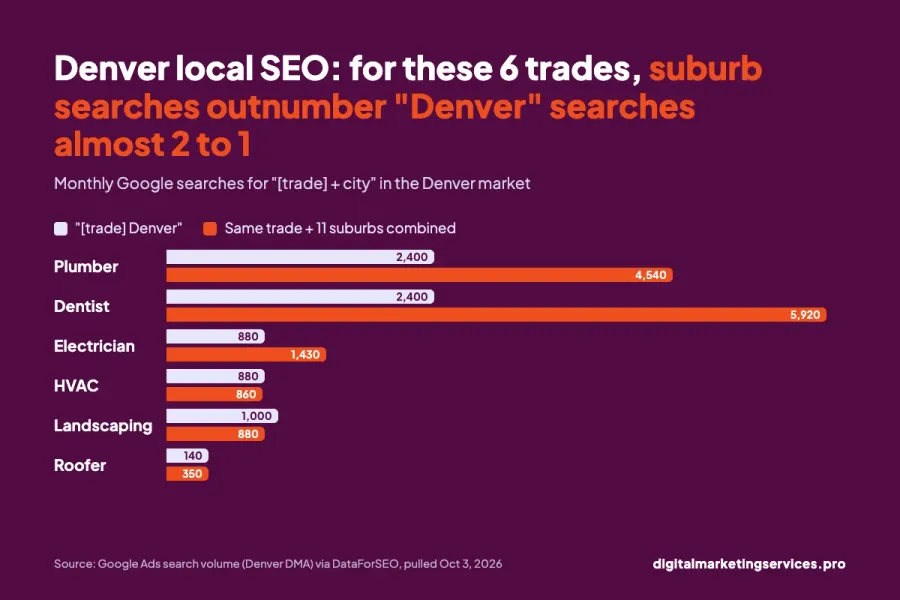
First, search volume. Using Google Ads data for the Denver market, I looked at six trades (plumber, electrician, roofer, HVAC, dentist, landscaping) paired with Denver and with 11 suburbs. Here’s what people actually type each month:
| Trade | ”[trade] Denver” | Same trade + 11 suburbs combined |
|---|---|---|
| Plumber | 2,400 | 4,540 |
| Dentist | 2,400 | 5,920 |
| Electrician | 880 | 1,430 |
| HVAC | 880 | 860 |
| Landscaping | 1,000 | 880 |
| Roofer | 140 | 350 |
| Total | 7,700 | 13,980 |
That’s 64% of the volume naming a suburb. And the real share is probably higher, because Google’s data had no number at all for a few combinations, like dentist plus Aurora.
Some suburbs punch way above their size. “Plumber Arvada” gets about 880 searches a month, more than Aurora at 720, even though Aurora is the much bigger city. “Dentist Littleton” gets around 1,900. Those are real markets on their own, with their own map packs.
Second, the map results. I checked Google Maps for “plumber” and “dentist” as if I were standing in six places: downtown Denver, Aurora, Lakewood, Littleton, Westminster, and Centennial. That’s 36 top-3 spots in total.
They showed 35 different businesses. Only one plumber appeared in two places. In 33 of the 36 spots, the business listed an address in the same city I was searching from.
Here’s the part that surprised me. A plumber with 2 Google reviews ranked #1 from the Aurora search point. In Westminster, a plumber with 8 reviews ranked #1, above a competitor with 2,543. And the plumbing company with the most reviews in the whole sample (4,406) only showed up from the Centennial point, near its office.
There’s a catch, though. Both of those low-review plumbers have the trade and the city right in their business name. That likely makes them look like a strong match for the search, on top of being close, so I can’t credit their wins to distance alone.
This lines up with what Google says it ranks on. According to Google’s own help page, local results are based mainly on relevance, distance, and prominence. Relevance is “how well a Business Profile matches what someone is searching for,” and “Distance refers to how far each business is from the customer who’s searching.”
So I wouldn’t read this sample as “being close beats having reviews.” What I’d take from it is that distance and relevance, including how well your name and profile match the search, often beat raw review count. Reviews still count, but they aren’t the whole race.
One warning before you rename anything. Google’s Business Profile guidelines say your name should reflect your business’s real-world name, and that adding unnecessary information to it isn’t permitted and could get your profile suspended. If your real name already says what you do and where, great. If it doesn’t, work on what you control: your categories, a complete profile, and pages that match the searches you want.
One honest caveat: this is a single snapshot from one day. Results change by device, time, and exact location. But I’ve shown the same distance effect with a real client’s rank grid in my Colorado Springs local SEO guide: a Pueblo business that ranks #1 to #3 around Pueblo doesn’t show up in the top 20 anywhere in Colorado Springs.
Step 1: Pick the part of the metro you can win
Most Denver businesses I talk to want to “rank in Denver.” That goal sounds right, but it sets you up to lose. Central Denver is where the biggest, most-reviewed companies cluster, and Google won’t show your Lakewood shop to someone in Five Points just because your site says Denver.
Instead, draw your real map:
- Your home base: the city your address is in. This is where you can win first.
- Your next ring: the 2 to 4 suburbs you actually drive to every week.
- Stretch areas: places you’d like to serve, but where you have no address and no history yet.
The Denver area isn’t one market. The Denver Regional Council of Governments lists nine counties and dozens of cities and towns as members. Each of those city names is a separate search, and the table above shows several of them have more demand than you’d guess.
If your business is in Arvada, “plumber Arvada” is a winnable, high-volume target. “Plumber Denver” is a long fight against companies with thousands of reviews and offices closer to downtown.
Step 2: Set up your Google Business Profile the right way
Your Google Business Profile (the listing that shows on Google Maps) is the single biggest lever in local SEO. I cover the full setup in my Google Business Profile optimization guide. For Denver businesses, three things matter most.
Use a real address, or none. Coworking spaces and virtual offices are everywhere in Denver, and they’re a trap. Google’s Business Profile guidelines are blunt: “If your business rents a physical mailing address but doesn’t operate out of that location, also known as a virtual office, that location isn’t eligible for a Business Profile.” A profile built on a virtual office can get suspended, and you lose everything on it.
Service-area businesses hide the address. If you go to your customers (plumbers, roofers, cleaners), Google says to hide your address and list the areas you serve. List the suburbs from Step 1, not every city in the metro. Distance still counts from where you’re actually based.
Get your categories right. Your primary category does more work than almost anything else on the profile. In a crowded market, the right secondary categories help you show up for related searches. I wrote a separate guide on choosing Google Business Profile categories because people get this wrong so often.
Also: one listing per location. Google’s guidelines say not to create more than one profile for each location of your business. Duplicate listings split your reviews and confuse Google about which one is real.
Step 3: Build real pages for the suburbs you serve
Your website tells Google what you’re relevant for. (If your site itself needs work first, my Denver web design guide covers what to fix.) If your site only says “Denver,” Google has little reason to show you for “electrician Westminster.”
The fix is a page for each city in your home base and next ring. Not 40 copy-paste pages with the city name swapped. Google can spot those, and so can your customers. Each page should say something only that area’s page could say:
- Which jobs you’ve done there, and what they involved
- Neighborhoods and landmarks you actually work around (Olde Town Arvada, Belmar in Lakewood, the Highlands, Central Park, which used to be called Stapleton)
- Photos from real jobs in that city
- Reviews from customers who live there
If you only have real material for three suburbs, build three pages. Three strong pages beat twenty thin ones.
Within Denver itself, the same logic applies at the neighborhood level. Cherry Creek, RiNo, LoHi, Wash Park, and Capitol Hill are places people name when they search. If you have real work and real customers in one, that’s worth a section or a page.
This is the work I do in my local SEO service: pages built around where your customers actually are, not a template.
Step 4: Earn reviews without breaking Google’s rules
Reviews feed the “prominence” part of Google’s ranking. Google’s help page says “More reviews and positive ratings can help your business’s local ranking,” and replying to reviews helps too.
But my data shows reviews aren’t a numbers race against the whole metro. You need to compete with the businesses near you, not the 4,000-review company across town.
What works:
- Ask every happy customer, every time. Make it part of finishing the job: a text with your direct review link, sent the same day.
- Reply to every review. Good ones get a thank-you. Bad ones get a calm, specific response and an offer to fix it offline. People read those replies.
- Make it steady. A few new reviews every month looks better, to customers and to Google, than 30 in one week and nothing after.
What gets you in trouble: Google’s fake engagement policy bans offering “payment, discounts, free goods and/or services” in exchange for posting any review. It also bans businesses that “selectively solicit positive reviews from customers.” So no discounts for reviews, and no sending only your happy customers to Google while unhappy ones get a private form.
Step 5: Build local authority in Denver
The last piece is getting other Denver-area websites to mention and link to you. Google’s ranking page names “how many websites link to your business” as part of prominence.
Start with the basics, then go local:
Citations. Your business name, address, and phone number listed the same way everywhere: Google, Bing, Apple Maps, Yelp, the Better Business Bureau, Nextdoor, and your industry’s main directories. My citation building guide covers which ones matter.
Your local chamber. The Denver Metro Chamber of Commerce is the big one, but suburban chambers are often easier to join and more active. If you’re in Aurora, look at the Aurora Chamber. If you’re in Jefferson County, look at West Chamber. A membership listing is a real local link, and the events are where referrals start.
Local press and community. Outlets like the Denver Business Journal, Westword, 5280, and Denverite cover local businesses. You won’t get coverage for being open. You might for a real story: a big community project, a unique service, a fundraiser you ran. Sponsoring a youth team or a neighborhood event usually earns a link from the organizer’s website too.
None of this is fast. But it’s what separates businesses that hold their rankings from businesses that slip the moment a competitor tries harder.
How long it takes (with Colorado examples)
I don’t have a Denver Google Maps client to show you yet, so here’s what I’ve seen in other Colorado markets, with the honest context.
Wedding DJ Colorado, Pueblo. The owner was invisible on Google, around position 20 or lower for “wedding DJ.” I built a 47-page site with location pages, set up the Google Business Profile properly, and he hit #1 for “wedding DJ Pueblo” six days after launch. The full case study has the numbers. But Pueblo is a much smaller market than Denver. Don’t expect six days for “plumber Denver.”
Best Construction Brands, Colorado Springs. In 2024, this bathroom remodeler went from #13 to #2 on Google Maps in 60 days. That’s a more typical pace for a competitive trade in a mid-sized city.
Secrets of the Tribe, Denver. My one Denver client so far was an online store, not a map-pack business. Working with my partner eSEO Space in 2024, we got them to #1 on Google for 49 searches in three months. Different kind of SEO, same lesson: pick searches you can win and build pages that deserve to rank.
For a Denver service business doing the steps above, I’d plan on 60 to 90 days before the map results really move, and longer in plumbing, dental, legal, and HVAC.
Your Denver local SEO checklist
Use this to check where you stand:
- I know which 1 to 4 cities I can realistically win, starting with the one my address is in
- My Google Business Profile uses a real address I operate from, or hides it as a service-area business
- My service area lists the suburbs I actually serve, not the whole metro
- My primary category is the most specific one that fits, and my secondary categories match my real services
- I have exactly one profile per location, with no duplicates
- My website has a real page for each city in my home base and next ring, with local jobs, photos, and reviews
- Every finished job gets a same-day review request, with no incentives and no filtering
- I reply to every review, good and bad
- My name, address, and phone number match on Google, Bing, Apple Maps, Yelp, BBB, and Nextdoor
- I belong to at least one local chamber or business group with a website listing
If you want a second set of eyes on any of this, I offer a free local SEO audit for Denver-area businesses. It’s me looking at your profile, your site, and the map results in your part of the metro, then telling you straight what I’d fix first. You can also see how I approach SEO for Denver businesses, or read my complete local SEO guide if you’re outside the metro.
Frequently Asked Questions
Focus on the part of the metro around your address, not all of Denver. Google ranks local results by relevance, distance, and prominence, so a complete Google Business Profile, a page for each suburb you actually serve, steady reviews, and links from local organizations will move you faster than chasing the word Denver everywhere.
Fewer than most people think, if you're close to the searcher and clearly match the search. In my October 2026 check, a plumber with 2 reviews ranked #1 near its own address in Aurora. Its business name also includes the trade and the city, though, so distance probably wasn't the only reason it won. Reviews feed prominence, but distance and relevance (including how well your name and profile match the search) often decide who shows up first. Don't stuff keywords into your name to copy this, because Google requires your real-world business name. Aim to beat the businesses in your immediate area, not the biggest names in the metro.
Usually your suburb first. For the six trades I checked, 64% of the trade-plus-city search volume in the Denver market named one of 11 suburbs instead of Denver. If you're in Arvada or Littleton, your own city name is often the bigger opportunity and the easier one to win.
No. Google's guidelines say a rented mailing address you don't operate from isn't eligible for a Business Profile. If you serve customers at their location, set up as a service-area business and hide your address instead.
Expect real movement in 60 to 90 days for a well-run campaign, longer in crowded trades. I've seen a Pueblo business hit #1 in 6 days, but Pueblo has far less competition than central Denver. Plumbing, dental, and legal in Denver take longer because the businesses already ranking there have strong profiles.